
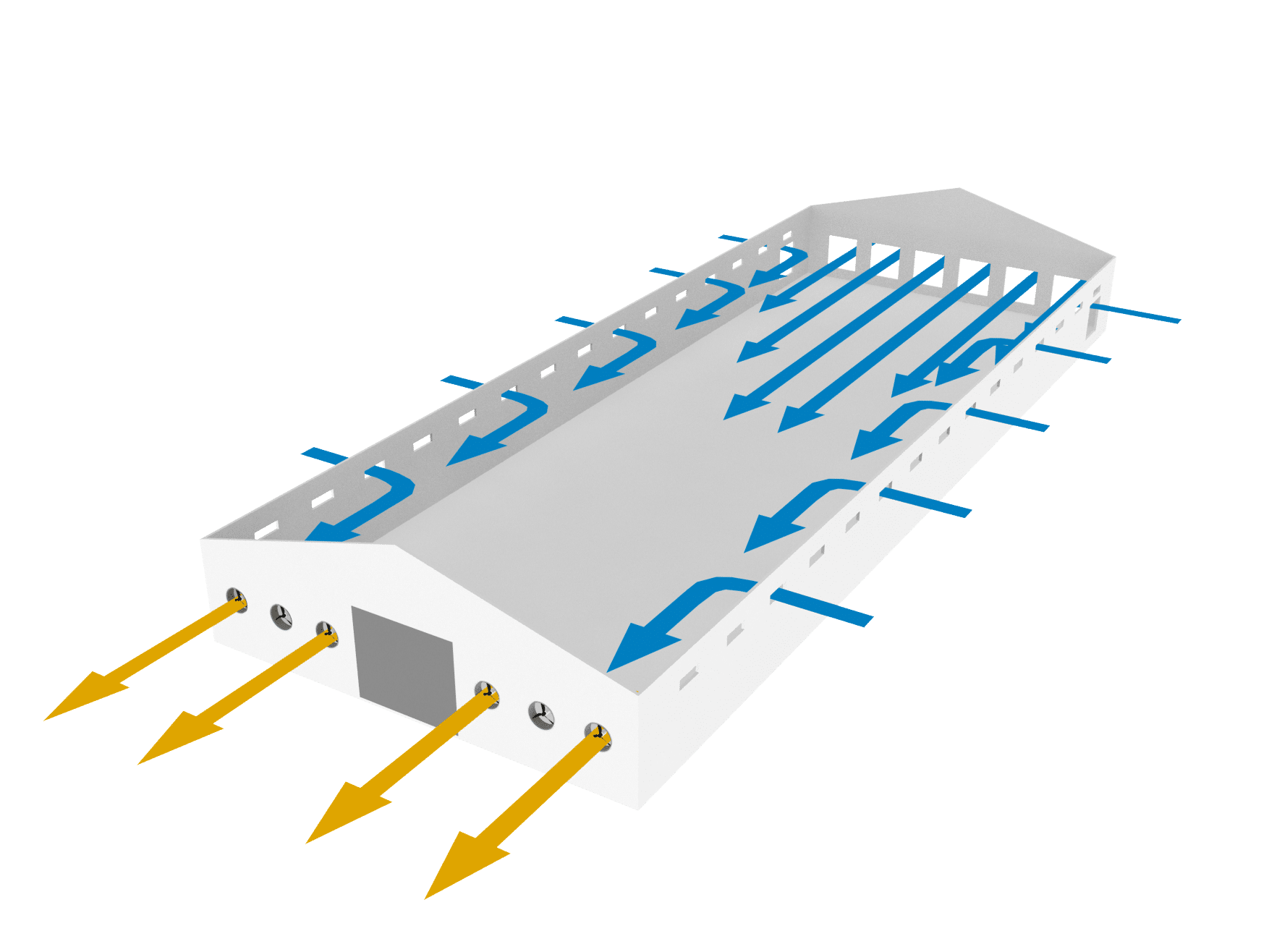
Proper ventilation in a broiler chicken house is essential for maintaining air quality, regulating temperature, removing moisture and ammonia, and supporting optimal bird health and growth. To determine the correct amount of ventilation, several factors must be considered: bird age, number of birds, house size, and seasonal climate.
- Ventilation Rate Per Bird
Ventilation needs increase as the birds grow. Below is a general guideline for air exchange rates per bird at different stages:
| Age | Minimum Ventilation (liters/hour/bird) | Maximum Ventilation (Summer) (m³/hour/bird) |
|---|---|---|
| 1–7 days | 0.5–1.0 L/h/bird | 2–3 m³/h/bird |
| 3 weeks | ~5–6 m³/h/bird | 10–12 m³/h/bird |
| 5–6 weeks | 8–10 m³/h/bird | 15–20 m³/h/bird |
- Example Calculation
Assumptions:
20,000 broiler chickens
- Birds are 5 weeks old
- Summer conditions – target ventilation: 15 m³/h per bird
Required airflow:
20,000 birds × 15 m³/h = 300,000 m³/hour
If each exhaust fan has a capacity of 25,000 m³/h, then:
Required fans:
300,000 ÷ 25,000 = 12 fans
Always plan for 10–20% extra capacity as a safety margin.
- Other Factors to Consider
- House design: Dimensions (length, width, height)
- Ventilation method: Cross, tunnel, or natural
- Airflow direction and placement of fans/inlets
- Climate control systems: Temperature sensors, humidity control
- Volume of the house (cubic meters)
- Bird density and litter moisture

Conclusion
Calculating the proper ventilation in a broiler house is critical for flock performance and welfare. Start with per-bird airflow estimates based on age and climate, then scale up to your flock size. Consider equipment capacity and always validate your setup under real-world conditions.
We have a wide range of farm ventilation spare parts- Click here